
99 Years of Wisdom Condensed Into 20 Mental Models
I started investing thanks to Charlie Munger, so it’s an honor for me to help spread his wisdom.

I immersed myself in Charlie Munger’s wisdom by listening again to dozens of his interviews and rereading Poor Charlie’s Almanack. From there, I pulled out 20 of Charlie’s mental models which are, in my view, largely responsible for his success.
And I’m not the only one who thinks so:
“I think Charlie reads probably more than one or two books a day. But neither his large brain nor the sheer volume of data going into it is responsible for his success, in my opinion. What I believe is truly responsible for his success is his mental-model hacks.”
Mohnish Pabrai
Let’s dive straight in:
1. Be a Swiss Army Knife
Each discipline has a lot to offer. Knowing the big ideas from each one and making them your own gives you a more integrated view of the world and a more general way of approaching problems. The trade-off between the cost of not having these tools and the cost of acquiring them makes it an obvious choice.
“The man who needs a new thinking tool but hasn’t yet acquired it is already paying for it.”
Charlie Munger
2. Deserve It Until You Get It
The best way to get what you want is to act in a way that makes you worthy of it. Time will inevitably do its work.
It’s such a simple idea. It’s the golden rule, so to speak: You want to deliver to the world what you would buy if you were on the other end. […] By and large the people who have this ethos win in life and they don’t win just money, not just honors. They win the respect, the deserved trust of the people they deal with, and there is huge pleasure in life to be obtained from getting deserved trust.
Charlie Munger
3. Manage Happiness Through Expectations
Happiness is mainly the result of the gap between the outcomes of our actions and our expectations. By lowering our expectations, we can reduce a lot of unnecessary suffering (for example, by taking fewer risks to reach them).
“A happy life is very simple. The first rule of a happy life is low expectations. It’s one you can easily arrange. And if you have unrealistic expectations, you’re going to be miserable all your life.”
Charlie Munger
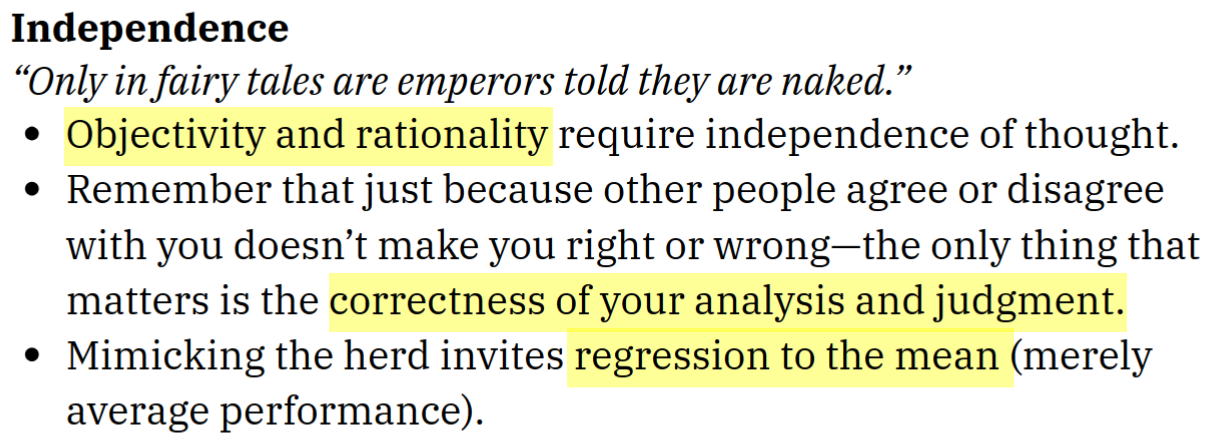
4. Independent Thinking to Counter Self-Serving Bias
You are (almost) the only person naturally incentivized to care about your success. Everyone who gives you an opinion or a business idea—even experts—has incentives that are not necessarily aligned with yours. Independent thinking is the only way to align your decisions and your incentives with your own success.
“You must have the confidence to override people with more credentials than you, whose cognition is impaired by incentive-caused bias or some similar psychological force that is obviously present.”
Charlie Munger
5. See the World Through the Lens of Incentives
Human behavior is driven by classical and operant conditioning. Over the long term, it is rewards and punishments—in other words, incentives—that shape these patterns of conditioning, and therefore behavior.
“Show me the incentive and I’ll show you the outcome.”
Charlie Munger
6. Reduce Competition Through Specialization
Those who perform the best are often the most specialized. The more specialized you are, the less competition you face and the more you’re rewarded for it.
“Specialization is the safest way out for most people, and for that reason the surgeons know more and more about less and less, and that’s what gets rewarded.”
Charlie Munger
7. Time Is Limited, Use Filters
The rarest resource we have is our time. It is essential to save it, especially in an age filled with noise. Use as many filters as possible to categorize as much information as possible, as quickly as possible (for example, the “too hard” pile).
“We have three baskets for investing: yes, no, and too tough to understand.”
Charlie Munger
8. Two Kinds of Knowledge
Not all knowledge is equal. Not all people who share knowledge are equal. Look for those who have a deep understanding of their subject and can adapt what they know to each situation, rather than someone who simply repeats what they think they know.
“In this world we have two kinds of knowledge. One is Planck knowledge—the people who really know. Then we’ve got the chauffeur knowledge—they have learned to prattle the talk and they have a big head of hair […] but in the end, it’s chauffeur knowledge.”
Charlie Munger
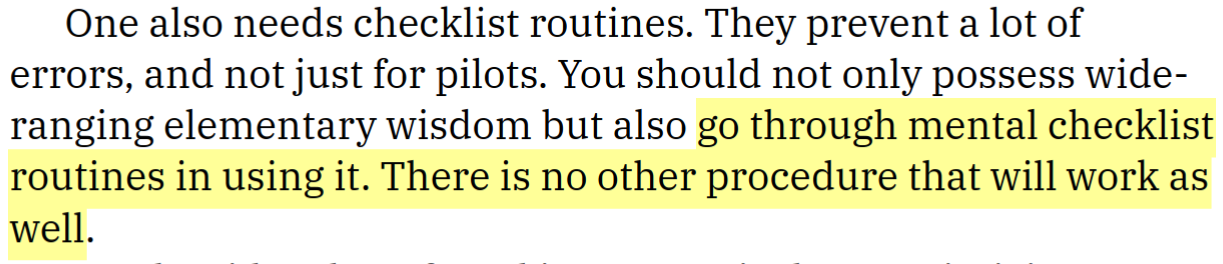
9. Checklist Against Complexity & Bias
Any process where error is too costly uses checklists (nuclear safety, aviation, investing, etc.). It’s a method that’s too simple and too effective at limiting potentially very costly mistakes not to be used.
“I’m a great believer in solving hard problems by using a checklist. You need to get all the likely and unlikely answers before you.”
Charlie Munger
10. The Iron Prescription
Refuse the victim posture, even in an unfair world. In his early 50s, a botched cataract surgery left Charlie Munger blind in his left eye. Doctors warned he could lose vision in his remaining eye. Despite the unfairness of it, he didn’t waste time complaining and simply started taking Braille lessons—a pure display of pragmatism. Fortunately, the condition later eased, and he kept sight in his right eye.
“Whenever you think that some situation or some person is ruining your life, it’s actually you who are ruining your life. It’s such a simple idea. Feeling like a victim is a perfectly disastrous way to go through life. If you just take the attitude that, however bad it is in any way, it’s always your fault and you just fix it as best you can—the so-called ‘iron prescription.’”
Charlie Munger
11. Win-Win-Win
Value creation is more likely when all the players have an interest in keeping the system going. Here, the key actors are:
Customers
Companies (management, employees, etc.)
Investors
The point is not that opportunities exist only in this kind of scenario, but that you can quickly and easily eliminate a large number of potential companies and focus on the signal when all types of actors win.
I had dinner with Charlie. I said, “Charlie, have you heard of a company called Credit Acceptance?” He said no. So I said, “Let me describe the business to you,” and I spent less than a minute explaining Credit Acceptance—exactly the way I just explained it to you.
He cut me off and said, “We’re not interested in that kind of business.” That really surprised me, so I asked why. He said, “We don’t want to do predatory lending. We don’t want win-lose business models.”
[…] Charlie’s standard was basically: you can’t make a lot of money by taking the high road. So he immediately rejected Credit Acceptance.
Source: Mohnish Pabrai’s Guest Lecture at University of Nebraska, Omaha on October 15, 2024
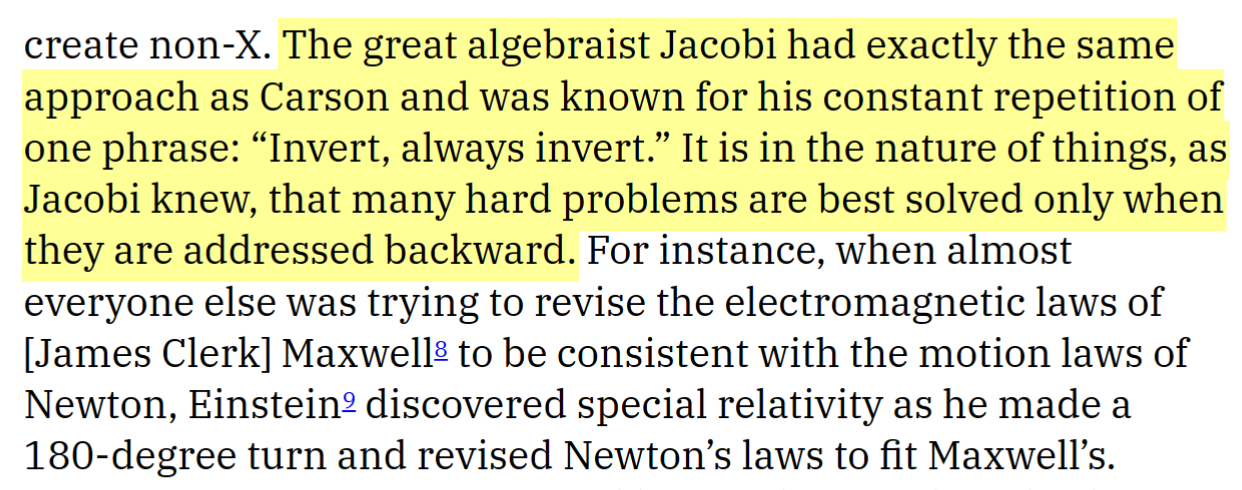
12. The Inversion Process
In most problems where uncertainty reigns, it can be very hard to reach an extremely desirable solution. In this kind of situation, an excellent heuristic is to invert the problem and avoid undesirable outcomes rather than trying to find the extremely desirable ones.
13. Probability Against Uncertainty
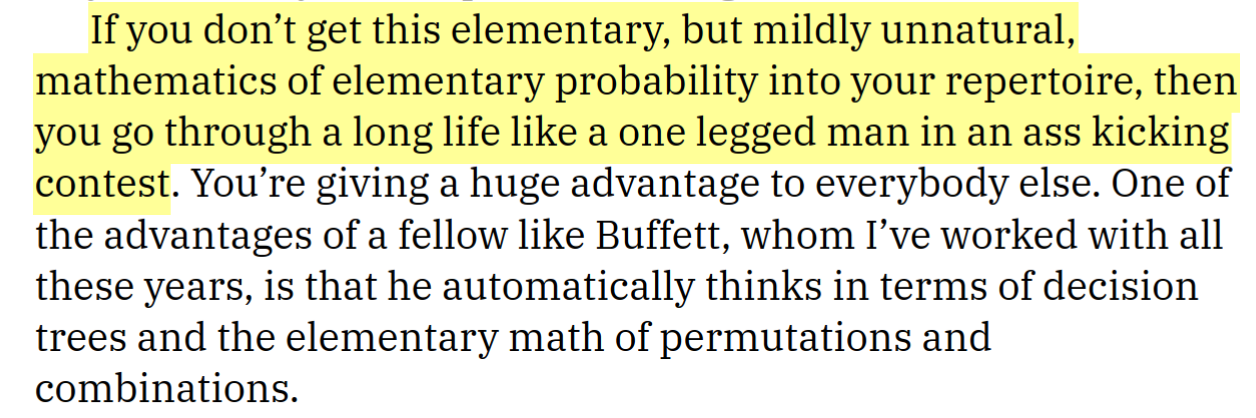
Uncertainty is a component of almost every environment, and definitely of investing. Probabilities are, among other things, a tool for measuring that uncertainty. Not thinking in terms of probabilities means dooming yourself to repeat the same mistakes over and over, sometimes with catastrophic consequences.
14. Opportunity Cost
Every limited resource (time, attention, money, relationships, etc.) that you spend on one thing is no longer available for all the others. Not taking these potential alternatives into account in your final decision means accumulating hidden costs.
I think this mental model of always thinking in terms of opportunity cost is the most important on this list in investing, and probably in life (although in a way, it is intrinsically linked to probabilities).
Opportunity cost is a superpower, to be used by all people who have any hope of getting the right answer.
Charlie Munger
15. Six Checks to Have a Better Life
It’s simple:
You don’t have a lot of envy.
You don’t have a lot of resentment.
You don’t overspend your income.
You stay cheerful in spite of your troubles.
You deal with reliable people.
You do what you’re supposed to do.
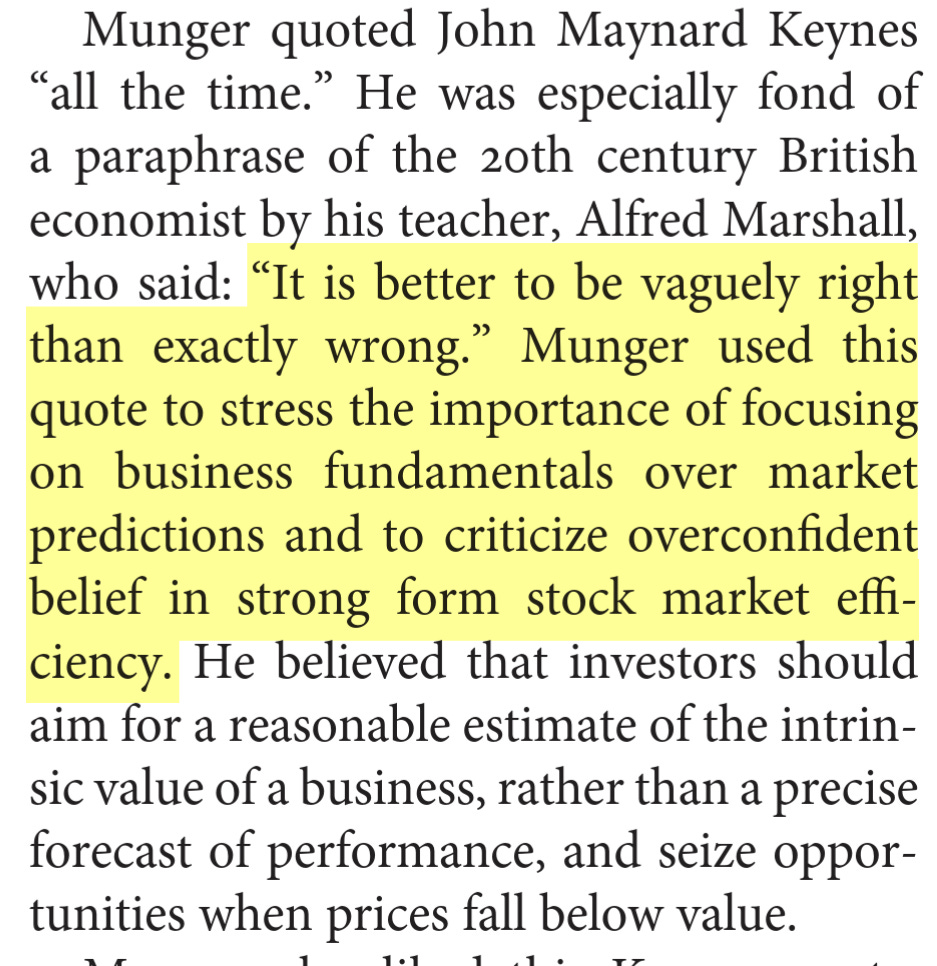
16. Vaguely Right > Precisely Wrong
The opportunity cost of precision (time, attention, etc.) is often much higher than the opportunity cost of being vague. When you add the uncertainty about actually being right and about the gains or losses tied to it, you often end up concluding that the opportunity cost of keeping things simple makes being vaguely right better than being precisely wrong.
“It isn’t that we were so good at doing things that were difficult. We were good at avoiding things that were difficult, finding things that were easy.”
Charlie Munger
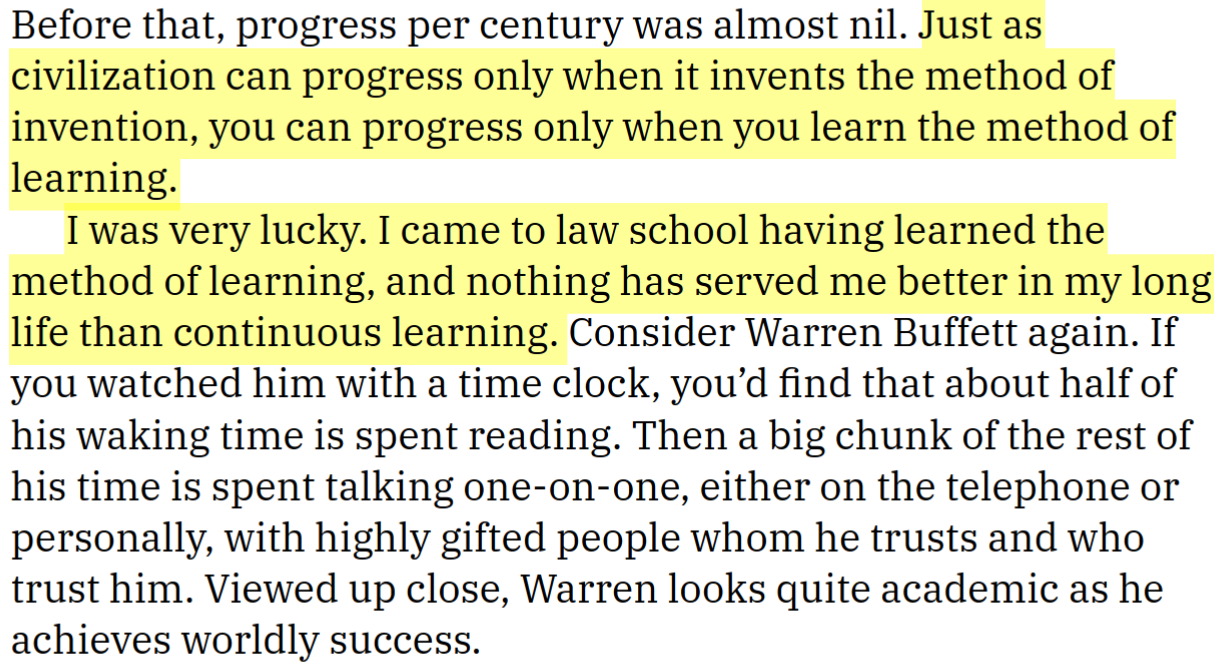
17. Learn to Learn
Learning is something you’ll be doing all your life (hopefully). You’d better read the few pages of your brain’s “manual” that science has discovered so far so you can get better at it as quickly as possible.
For a comprehensive summary of this manual: Improving Students’ Learning With Effective Learning Techniques: Promising Directions From Cognitive and Educational Psychology
“Without the method of learning, you’re like a one-legged man in an ass-kicking contest. It’s just not going to work very well.”
Charlie Munger
18. Learn to Unlearn
Our brain is wired to pay attention to information that aligns with our existing beliefs. This tendency limits our ability to unlearn false beliefs and therefore reduces the quality of our decisions.
“One should recognize reality even when one doesn’t like it, especially when one doesn’t like it.”
Charlie Munger
“It’s not the learning that’s so hard, it’s the unlearning.”
Charlie Munger
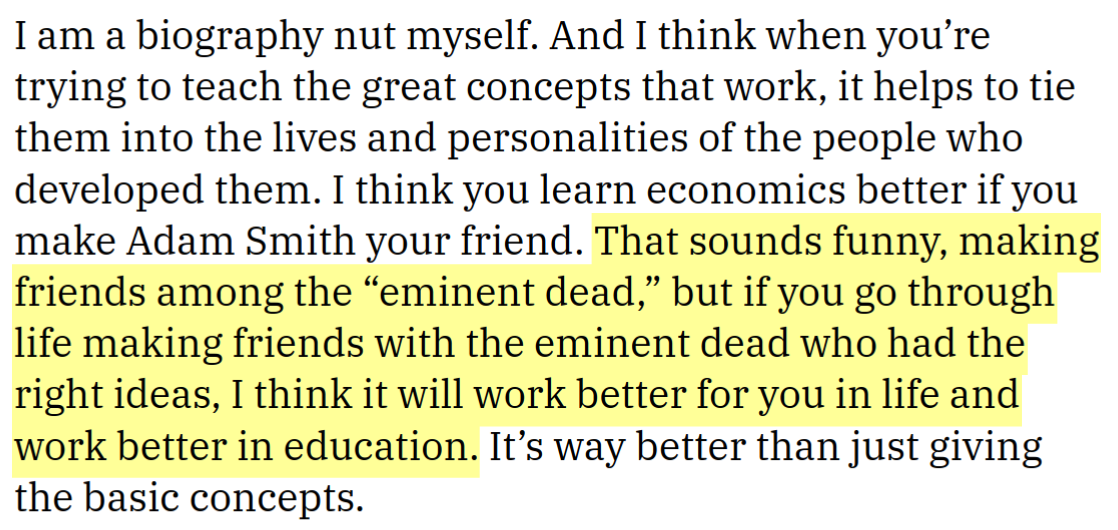
19. Make Friends with the Eminent Dead
It’s estimated that around 117 billion humans have lived on Earth. Only about 8.2 billion are alive today. A large share of existing wisdom was produced by people who are now dead. Charlie Munger himself is proof of that: he’s been among the eminent dead since late 2023.
Read the dead. Statistically, it’s more likely to be worth it.
“The man who doesn’t read good books has no advantage over the man who can’t read them.”
Mark Twain
20. Lollapalooza Effect
For the sake of simplicity, humans have classified the concepts they discover or invent into categories: physics, psychology, economics, etc.
However, the world is a continuum of structures and phenomena with no clear boundaries. Many phenomena arise from several disciplines, and many interact with each other across these borders.
The Lollapalooza effect is precisely when several forces (psychological, economic, social, environmental, etc.) act simultaneously in the same direction, creating an impact far more powerful than the sum of each force taken in isolation. In a sense, you move from addition to multiplication, leading to consequences that can be dramatic or exceptional.
“The lollapalooza effects can make you rich, or they can kill you.”
And voilà.
I could have kept going for a long time. I’ve been exposing myself to Charlie Munger’s wisdom more or less continuously for years, but this new deep dive still hit me hard. There is so much wisdom spread across his 99 years of life that it’s hard to come out untouched every time you immerse yourself in it.
To be frank, I already have enough material for a Part 2, but I didn’t want to discourage readers with 40 mental models. So I’m calling on your opinion:
Take care,
Masters of Compounding
Vaguely right > Precisely wrong
Managing expectations
Being friends with the eminent dead
Inversion
Checklists...
I might as well reproduce the whole list here! Great post.
#10,15,17 Oh, all of them!