
The Worst Place to Look for Alpha
You don't have to pick Dwayne Johnson for an arm-wrestling match.

Here is the deal:
Pick anyone you want for an arm-wrestling match.
+$10,000 if you win.
–$10,000 if you lose.
Of course, you wouldn’t pick Dwayne Johnson.
You’d look for the smallest, frailest opponent you could find, win quickly, take the $10,000, and compensate them for their time.
But you wouldn’t pick Dwayne Johnson.
Even if the word “arm-wrestling” made you think of him first.
Even if everyone else picked him.
You’d pick the opponent that makes winning easiest.
Agreed? Great.
Now let’s change the game.
Imagine an active investor managing 8 figures or less.
You’d expect him to do the same: pick the arena where winning1 is “easiest”, not where the strongest players in the world are already fighting with better tools.
So he wouldn’t:
focus on the part of the market where prices are less inefficient,
compete directly against the biggest, smartest players,
in the most crowded names.
He’d go where:
there are fewer competitors,
his edge actually matters,
and inefficiencies are still meaningful.
Even if everyone is talking about the big names.
Even if the first tickers that come to mind are mega caps.
Even if the crowd keeps piling into the same companies.
Yet most investors go straight for Dwayne Johnson. Here’s why.
Read This Before You Do Something You Could Regret
To avoid talking past each other and/or getting into heated debates, here’s exactly what I mean in this post:
“Investor” = an active investor managing < $50M
“Active” = active on two dimensions:
stock selection
time horizon (from a few months to a few decades)
“Small caps” = market cap < $1B, with sufficient liquidity
Competence assumption: if an investor can do stock picking in large caps, they can do it in small caps too.2
Let’s begin.
Good Answers, to the Wrong Question
I’ve had countless conversations with small-cap active investors who are anti–small caps.
When I ask, “Why don’t you focus on small caps?”, I always get the same sempiternal three arguments:
Large caps are much less risky (fraud/bankruptcy) and less volatile.
There are far more bad companies in small(er) caps.
Information on large caps is higher quality and more transparent.
All of that is true. And that’s exactly why an active investor should generally avoid large caps.
When the goal is to generate alpha3, there’s only one question to ask:
“Where do my efforts have the best chance of paying off, given the risks I take and the time I spend?”
The answers are simple:
Where other investors don’t like to go, because they fear perceived risk and volatility.
Where there are plenty of bad businesses, and where stock-picking skill is more likely to create an edge.
Where information is harder to find, and where individual research is more likely to create an edge.
Where you compete against fewer people who are smarter than you and better resourced than you.
In other words: smaller caps.
Their answers were good, but they answered the wrong question. In fact, they were the right answers to the inverse question.
That’s the theory. It still doesn’t explain why so many active investors end up focusing on large caps in practice.
Let’s talk about junk, availability, and blindness.
Size Matters, If You Control Your Junk
It’s possible to get rich by controlling your junk. Let me explain.
The “size premium” (the long-run outperformance of smaller companies) has sparked endless debate over the past 50 years.
But most of that debate rests on an assumption that, for the purpose of this post, is a mistake: it treats small caps as one homogeneous bucket.
In reality, small caps contain more “junk” on average and a much wider dispersion of quality. Treating them as a single bloc means refusing a very real selection opportunity, which, for an active investor, is pure alpha destruction.
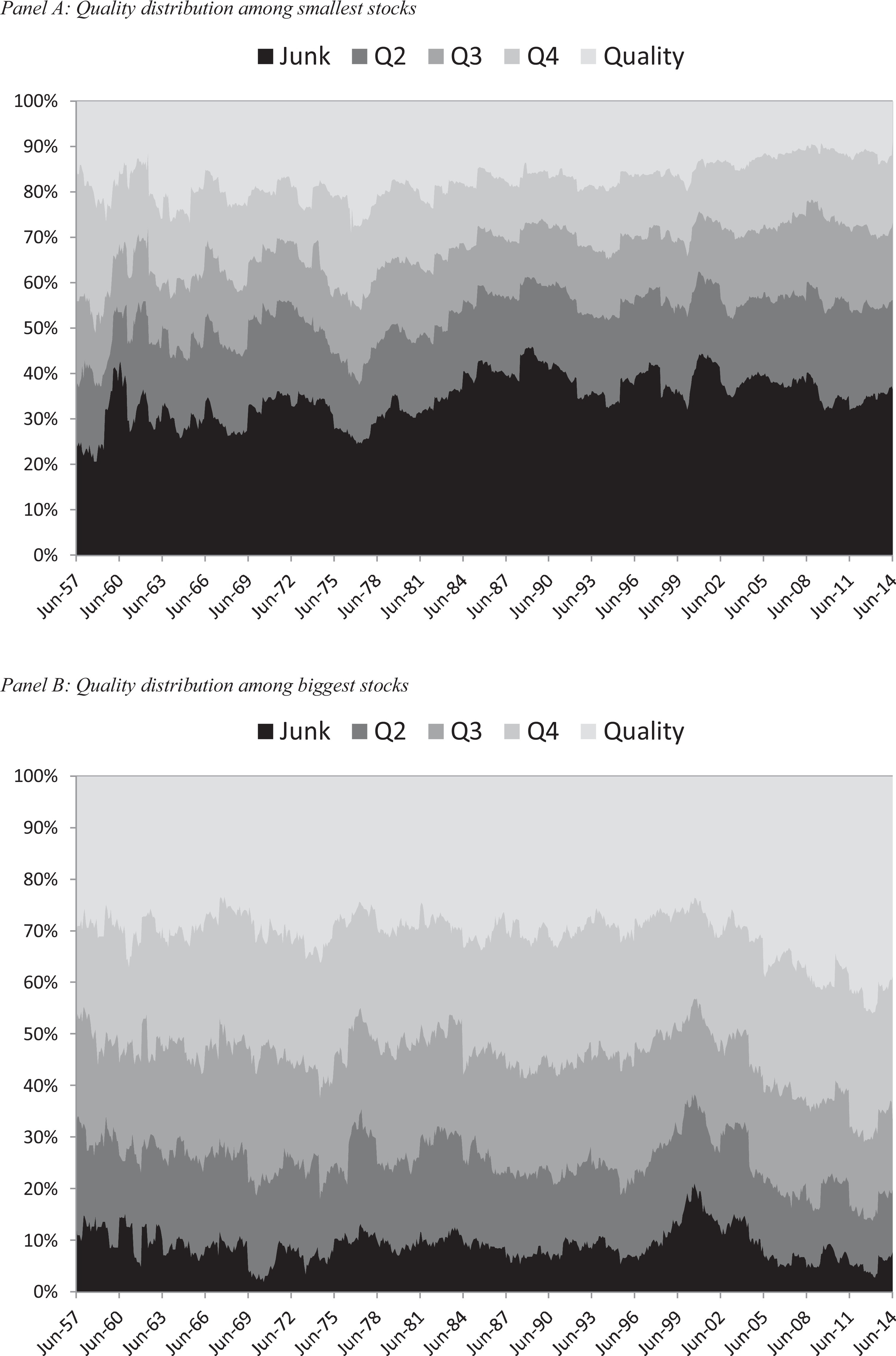
Fortunately, researchers re-examined the size premium by applying a simple quality filter to small caps; they call this “control your junk.”4
With these simple filters, the size premium not only becomes meaningfully larger, but the effect also shows up across:
virtually all countries,
virtually all industries,
in a way that’s robust and stable over time.
Better yet, it’s not one filter, it’s multiple filters.
There are five, and all of them improve performance. Here they are5:
Profitability (+5.16%/year) → higher margins, strong cash flows, and cash earnings that match accounting profits
Safety (+4.28%/year) → low leverage, stable profits, low distress risk
Payout (+5.28%/year) → limited dilution and meaningful cash returned to shareholders
Growth (+2.43%/year) → multi-year improvement in profitability (ROE/ROA/margins/cash flows)
All four combined (+6.04%/year)
These are paper estimates: they measure the “small” effect after statistical adjustments. They are not promises of returns.
If several different definitions of “quality” all point the same way, it says something fundamental: in small caps, filtering is the condition that makes the universe investable.
So what: does the lack of interest in small caps simply come from investors not realizing how heterogeneous they are, and how much filtering matters, therefore leaving all these opportunities on the table? Is that really the root cause?
Of course not.
This is one of the most competitive games on the planet (maybe the most). A simple lack of easily available information can’t be the explanation for that much apparent irrationality.
In situations like this, the thick description mental model is useful: look for the invisible constraints that explain the behavior, rather than defaulting to ‘irrationality.’
Since Kahneman and Tversky, and the death of homo economicus, the prime suspect is almost always the same: investor psychology.

The Pernicious Inheritance
Most investors don’t really choose their investing universe, they inherit it.
They show up with the same 30 names already printed in their heads:
the ones they hear everywhere before they’ve even opened an annual report,
the logos and jingles they’ve seen since childhood (e.g., home bias),
the stocks the “knowledgeable” coworker keeps repeating (often the one who got them into it in the first place),
add a pinch of social-media echo chambers (two “must-listen” podcasts, three viral threads…),
and voilà: a perfectly functional availability bias.
Availability bias is the tendency to make decisions based on the information that requires the least effort to access.
Where do most people go for finance information? Mainstream financial media: social platforms, TV, YouTube, and the rest.
And how do mainstream finance media become (and stay) mainstream? By talking about the mainstream companies that are most likely to interest the largest audience: large caps.
The snake is really eating its own tail. But we can go further.
Once you add the impact of other powerful biases, like:
confirmation bias (e.g., the 4th bullish thesis on a company mostly just reinforces what you absorbed from the first three),
anchoring (your baseline for what a “good” business looks like, what kind of volatility is “normal,” and so on),
you get a classic Lollapalooza effect: investors are almost inevitably pulled toward the same large caps, as if by gravity.
But that’s only the perception side of the story. If the problem stopped there, small-cap avoidance among small active investors wouldn’t be so persistent.
To go further, we need to look at how people react to these perceptions.
I Perceive, Therefore I Become
Let me borrow a concept from social psychology and tailor it to investing: cultural blindness.
If availability bias is about the first environment you’re exposed to, cultural blindness is what you do afterward, when you more or less willingly lock yourself into that environment and become blind (or impermeable) to everything else.
In investing, it’s something we all do:
when we subscribe to
thisa newsletter, a newspaper, a YouTube channel, etc.when we repeat a takeaway about a company that we first picked up through availability bias
and more subtly, when an algorithm “refines” what it shows us based on our clicks, or even the extra second we spend staring at a thumbnail
And those are just our internal incentives to build an environment that feels comfortable.
But our environment can be persuasive too:
Attention maximization: you talk about what everyone talks about (otherwise you’re talking to yourself.)
Social defensibility: picking ideas you can defend with standard references so it sounds “reasonable” before the results show up.
Shame asymmetry: a “mainstream” mistake gets diluted whereas an “obscure” mistake sticks.
And so on.
Add thousands of other small, subtle, mostly unconscious forces, and the combined pull becomes almost inexorable.6
So inexorable that it ends up shaping our “preferences” everywhere (music, sports, political views, etc.), to the point where we often confuse repeated exposure with genuine taste. Or maybe genuine taste is just repeated exposure.
Either way, a pattern this recurring probably deserves a few minutes of thought.
Just to be clear: my goal isn’t to convince you to invest actively in small caps.
Everyone chooses their game, and that’s perfectly fine.
Think of this post as a message in a bottle: one more perspective, take it or leave it.
Before I cork it and toss it back into the ocean, let me slip one last note inside:
If I was running $1 million today, or $10 million for that matter, I’d be fully invested. Anyone who says that size does not hurt investment performance is selling.
The highest rates of return I’ve ever achieved were in the 1950s. I killed the Dow. You ought to see the numbers. But I was investing peanuts then.
It’s a huge structural advantage not to have a lot of money. I think I could make you 50% a year on $1 million. No, I know I could. I guarantee that.
Warren Buffett
Take care,
Masters of Compounding
NFA: THIS IS FOR INFORMATIONAL AND EDUCATIONAL PURPOSES ONLY AND DOES NOT CONSTITUTE INVESTMENT ADVICE.
“Winning” in this post is defined as the after-tax performance of the entire portfolio.
The larger a company’s market cap, the more economically significant (and typically more operationally complex) it is, which makes it harder for an investor to fully analyze. If an investor has the time and skill to analyze large caps, they should be at least as capable of analyzing small caps.
The subtext is that an active investor who knows they’d have better odds in small caps but chooses not to focus there for personal reasons isn’t the target of this post. Not every investor’s goal is to maximize outperformance (relative to risk) at any cost.
Asness, C., Frazzini, A., Israel, R., Moskowitz, T. J., & Pedersen, L. H. (2018). Size matters, if you control your junk. Journal of Financial Economics, 129(3), 479-509.
The filters are constructed mechanically from multiple metrics, standardized (e.g., via z-scores) and aggregated into a single composite score. See the paper for details.
That’s why defining your circle of competence is a real advantage: it forces you to choose your investing universe more deliberately, instead of letting your environment choose it for you, quietly and by default.
Great point. Investors' egos forces them to try to answer the tough questions, but that isn't where the biggest expected return is
Wow great post! I think I'm suffering from large cap cultural blindness.