
The Most Counterintuitive Study I’ve Read (on Risk)
I wanted to go with “The Most Mind-Blowing Study In Investing,” which, at least from my perspective, would’ve been true. But it would’ve sounded too clickbaity.

Volatility isn’t risk. It’s a tax. And like any tax, not everyone pays it.
The only way to avoid the “volatility bill” is to be able to afford it.
Let’s use some remarkable data to show why.
The Man Who Had Only a Hammer
Picture the scene. You graduate with a master’s in economics. You’ve been handed a powerful tool: math. Naturally, you try to apply it everywhere.
Problem: “To the man with a hammer, every problem looks like a nail.”1
And when what’s in front of you doesn’t look like a nail? More often than not, you treat it like one anyway.
In finance, standard deviation (and its sister, variance) is the basic building block behind a whole toolbox: optimization, portfolio models, risk measures, allocation, and so on. It’s clean, computable, and it snaps neatly into elegant frameworks.
The central challenge of applied mathemathics, though, isn’t producing equations. It’s producing equations that stay close enough to reality.
When the model and reality don’t line up, you have two options:
adapt the tool to reality, or
adapt reality to the tool.
The second option is the easiest, the most comfortable, the most wrong… and the most common. It gives you “clean” results: easy to publish, present, and conclude from.
In our case, the guilty assumption is that risk = volatility.
In other words: we call “risk” the dispersion of returns around their average, measured by standard deviation.
“According to the academicians […], risk equals volatility. […] I take great issue with this definition of risk.”
Source: Oaktree Capital Management, memo “Risk” (2006)
And the nice thing about this kind of assumption is that it has a weak spot: find just one clean counterexample, and it collapses.
So that’s exactly what we’re going to do.
(Everything in this post stays in a long-term investing context.)2
Q.E.D.
Ontologically, risk is simple: an event with some probability X of happening, and, if it happens, some damage Y.
If I can show that:
the “risk event” occurs with 100% probability, and
when it occurs, it doesn’t cause damage,
then it becomes pretty hard to keep claiming that risk = volatility.
So, let’s go back to the future past.
We’re in 1927.
You’ve invented a time machine, but it still has two big constraints (you’ll have to build the v2):
it can only go five years into the future, and
it takes five years to recharge.
You’re smart. You buy the Grays Sports Almanac Wall Street Journal pages that list prices for the 500 largest companies.
You come back to the present with something absurdly valuable: the next five years of returns for each of those 500 companies, in black and white.
What’s the strategy? Go long the winners? No. You’re greedier than that: you go long the best performers and short the worst.
You do that every five years, all the way through 2016.
Now try to guess your CAGR over 90 years.
Seriously, take a few seconds. I think anchoring bias is about to do some work for me.
Here’s what you get:
Long the winners: 29.37% CAGR
Long the winners + short the losers: 46.23% CAGR
At this point you might be thinking: “What?! Only 46.23% CAGR even when I literally know the future? What a joke. Not even worth building this damn machine.”
You might be able to break the laws of physics by time traveling (especially the “going back” part), but you can’t break the laws of economics. (I’m kidding, kind of. Economics is downstream of physics anyway, so it’s the same thing.)
Because $1 compounding at 46.23% for 90 years turns into $713,300,000,000,000. $713T.
Put in just $100 back then and you’d end up richer than today’s entire global economy, which, obviously, makes no sense.3
Interesting. But what does this have to do with risk?
Simple: even with a literal crystal ball, even with returns that are basically divine, even going long the best and short the worst… you still would have experienced 50% drawdowns.
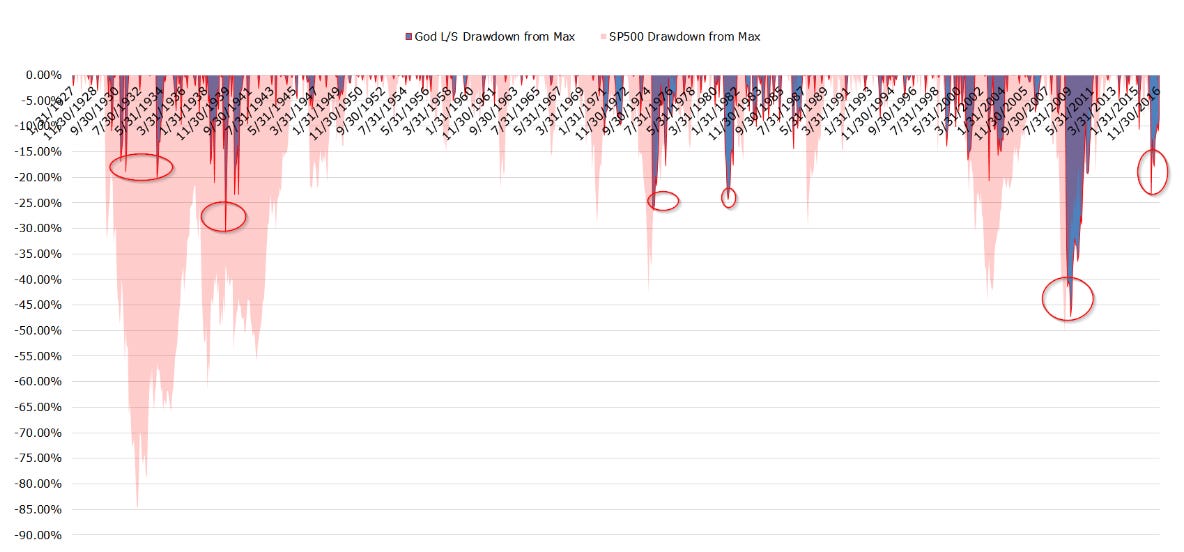
That part blows my mind: you know the future, you take the most profitable possible positions on both sides (long and short), and you still eat 50% drawdowns (and 75% if you’re long-only).
So let’s summarize:
You know you’re going to win. It’s inevitable. There is no “risk” in the sense of being wrong.
Volatility still shows up, repeatedly, and violently. And yet your performance is extraordinary.
So we’ve found a case where volatility:
occurs with 100% probability, and
when it occurs, it doesn’t cause damage because you are 100% sure you’ll win.
Volatility is present even in a world where there is literally no risk of being wrong.
So in long-term investing, risk is not volatility.
Q.E.D.
So What is Risk ?
The most useful approach is to ask people who’ve actually practiced long-term investing for decades, people who’ve experienced risk firsthand:
“Risk to us is the risk of permanent loss of capital.” — Charlie Munger
“The risk of an investment is described by both the probability and the potential amount of loss.” — Seth Klarman
“Risk comes from not knowing what you’re doing.” — Warren Buffett
“We define risk as the permanent loss of value per share.” — Nick Sleep
“The biggest investment risk is not the volatility of prices, but whether you will suffer a permanent loss of capital.” — Li Lu
I could keep going.
What they’re really talking about is permanent loss, probability, uncertainty, and understanding. If you compress all of that into one sentence:
Risk is anything that can make you lose money irreversibly, or force you to sell before you’re right.
Let’s unpack that definition.
Permanent Loss: The Real Risk
The most fundamental risk is the one you can’t come back from. No recovery. No do-over. It can come from:
A broken thesis → questionable management, disruption, the moat disappearing, bad capital allocation, etc.
A weak balance sheet → too much debt, dilution risk, covenants, and so on.
A bad entry price → paying too high a multiple, wrong assumptions on growth, no margin of safety.
In all of these cases, volatility is a cause of risk, not risk itself. It’s the market warning you before the final bill shows up.
Being Forced to Sell
This is probably the factor most standard models forget to account for.
That risk can come from:
Leverage on your capital → volatility triggers a margin call and you sell at the worst possible time.
Lack of liquidity → you sell to fund life, taxes, unexpected expenses, etc.
An asset that’s too illiquid → sometimes you can sell, but only at a brutal price. Other times there’s no bid at all, so you can’t sell even if you want to.
Constraints are the market’s most dangerous silent killer. Without constraints, a drawdown is just discomfort. With constraints, it can be a death sentence.
Minimizing constraints as much as possible is a rule every great investor has followed on their journey.
Not Knowing What You’re Doing
As always, Buffett’s words carry more weight than mine:
“Risk comes from not knowing what you’re doing.”
The subtext is simple: if you don’t understand what you own, you can’t tell the difference between:
a “normal” drawdown, and
a drawdown that reflects real deterioration, i.e., actual risk of permanent loss.
That uncertainty feeds a whole chain of biases that almost inevitably lead to value-destructive decisions (panic selling, averaging down blindly, etc.).
Volatility Is a Tax on Those Who Can’t Afford It
Volatility isn’t risk. But volatility is a:
horizon test
sizing test
liquidity test
understanding test
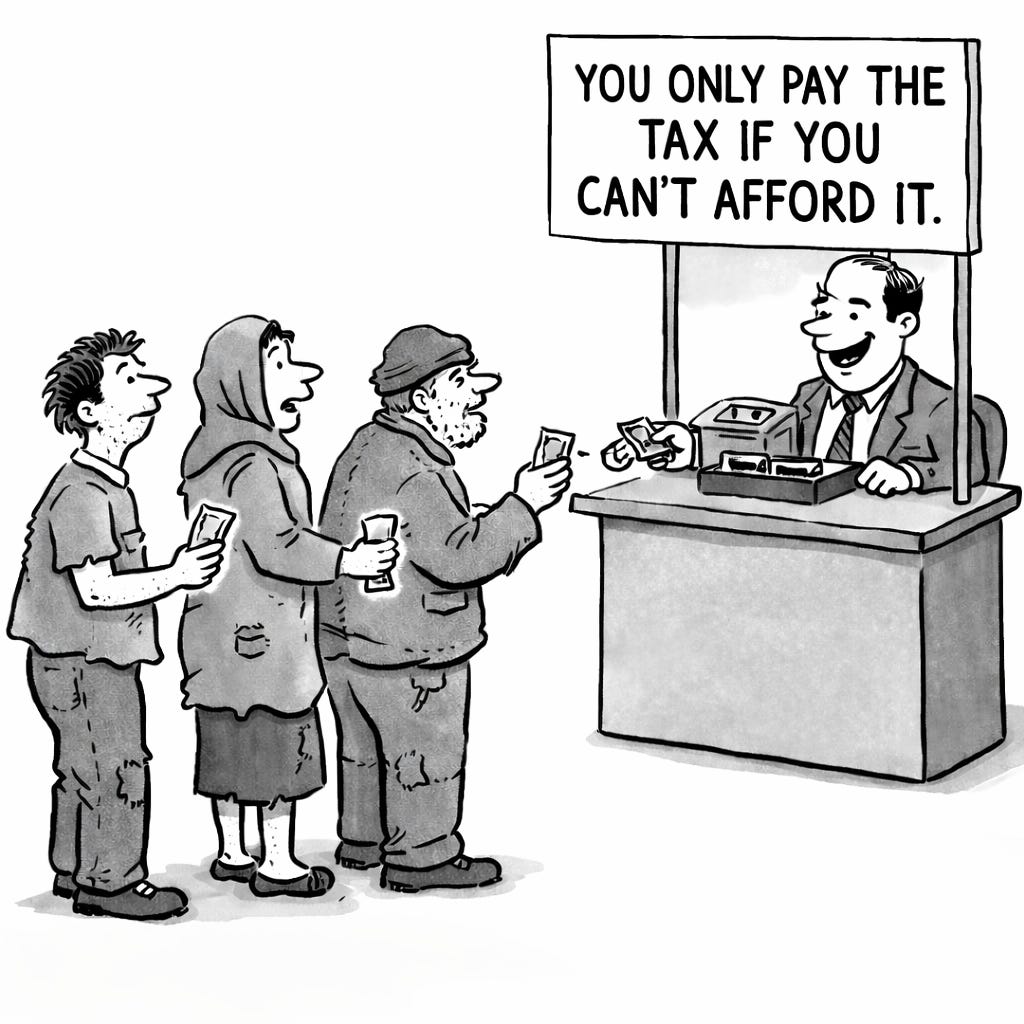
In other words, volatility is a tax you pay… but only if you don’t have the mental and financial infrastructure to pay it. You pay the tax precisely when you can’t afford to pay it.
As long as you can hold, financially and behaviorally, volatility becomes what it really is: an intrinsic feature of equity markets. A “bad” stretch to live through, and one that will eventually pass.
Risk, the probability of a permanent loss of capital (because of constraints or a broken thesis), is more pernicious. It can disguise itself as volatility. But only people who’ve done the work can recognize the disguise. Most of the time, anyway.
Risk Isn’t Bad. It’s the Game.
In an uncertain world, trying to “eliminate risk” doesn’t make sense. The only serious question is: what is this risk paying me?
Risk is always there. Upside isn’t. You can take very real risk… for zero upside, or a ridiculous payoff.
The goal isn’t to “reduce risk to zero.” The goal is to take bets where, on average, and over time, the possible gains dominate the possible losses.
In other words: take risks that are well-paid, with a structure that lets you survive long enough for the statistical edge to do its job.
In investing, the winners are the ones who don’t get taken out of the game.
Writing here is one way I increase my own odds of staying in the game.
I hope reading it helps increase your odds of staying in the game too.
Masters of Compounding
That quote refers to the law of the instrument, a cognitive bias Abraham Maslow spelled out in 1966.
I’m fully aware that most quants know this assumption is false and use it only as a proxy. My main criticism is that the proxy has been used so zealously that the simplicity/usefulness/truthfulness tradeoff has been pushed too far toward simplicity and usefulness, at the expense of truth.
These returns also break the laws of physics via feedback effects: your capital would get so large that when you deploy it into the stocks with the best returns over the next five years, your own position size would compress those returns.
It’s the same phenomenon that has, over time, reduced Berkshire Hathaway’s returns: as capital grows, size becomes a handicap. The sheer mechanics of deploying massive amounts of money end up squeezing performance.
I really enjoyed that! Great insight and food for thought. Thanks for sharing
Buy and hold , hold , hold Great companies …. That is the force that keeps volatility at bay .